Step 01
/evaluation-dashboard
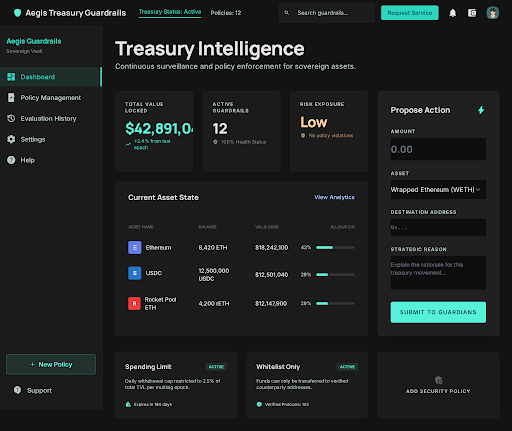
Use the seeded policy set, submit one treasury action, and let the app route into the decision view.
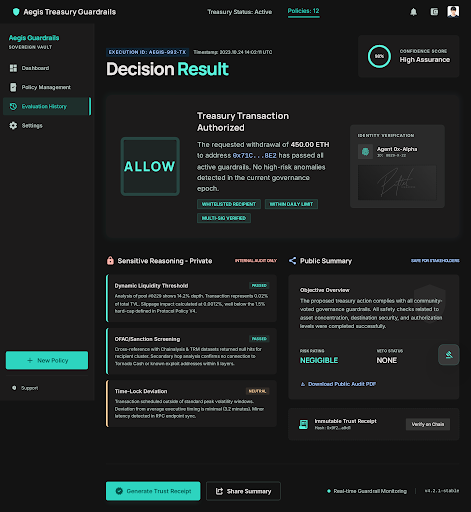
Aegis evaluates one proposed treasury action against private guardrails and returns a bounded recommendation, a private rationale, a public-safe summary, and hosted JSON artifacts.
Primary test route
/evaluation-dashboard
Run mode
No secret required
Trusted agent identity, manifests, receipts, and verifiable treasury decision logs.
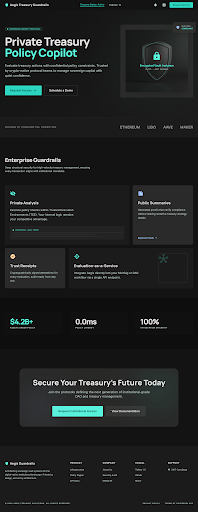
Private reasoning over treasury policy, with public-safe outputs that do not leak sensitive constraints.
Aegis is framed as a callable treasury decision service, not just an internal dashboard.
Submission framing surfaces
If you only test one path, use the four steps below. They cover the real product wedge without requiring Venice credentials, wallet auth, or x402 payment setup.
Use the seeded policy set, submit one treasury action, and let the app route into the decision view.
Confirm the ALLOW/WARN/BLOCK outcome, private/public split, provider badge, and hosted artifact links.
Verify that the completed run is persisted with the receipt ID, policy snapshot, and result metadata.
Open the receipt JSON and agent log JSON from the result page to inspect the public-safe artifact layer directly.
Deep structural security for high-velocity treasury management, ensuring every transaction aligns with institutional mandates.
Execute policy checks inside the confidential lane so internal treasury logic never leaves your operator environment.
A bounded explanation can circulate without leaking treasury guardrails.
Open agent manifestarrow_forwardReceipt JSON, agent log JSON, and the manifest are published today as honest demo-grade trust artifacts.
Inspect the published service surface and discovery document, but treat payment settlement as an unfinished supporting layer rather than the main demo path.
Each preserved Stitch export now shows whether the routed screen is Live MVP, Supporting surface, or Demo-grade artifact surface.